Arrest
unknown


Basic information
- ID
- Ivanova-33
- Author
- unknown
- Name
- Arrest
- Date of creation
- 1939
- Technique
- photocopy (printed on paper)
Additionally
- Genre
- everyday life
- Provenance
- Antonina Ivanova's archive
- Place
- Moscow (the USSR)
Information about author
Object description
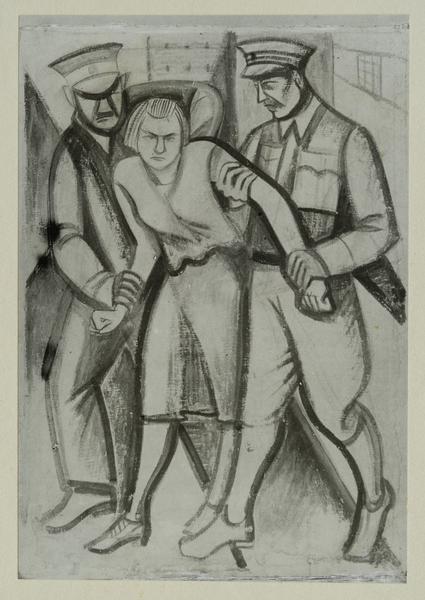
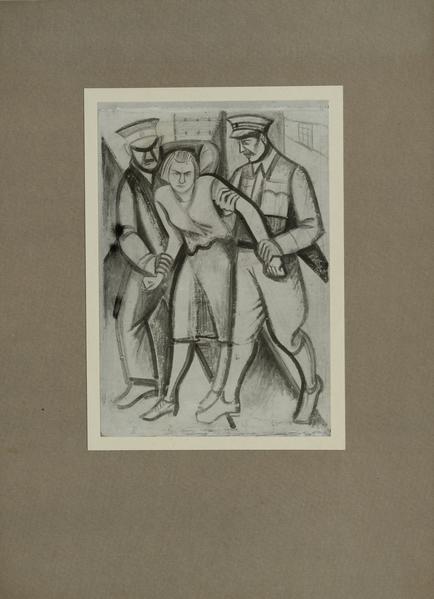
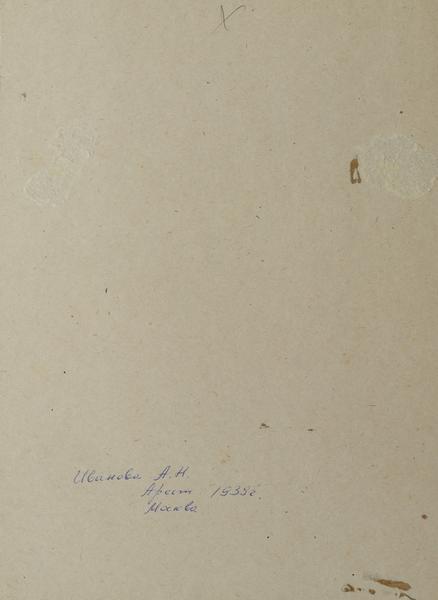
The photograph shows the work of Antonina Ivanova, signed "Arrest" (on the back of the photograph, there is an inscription in russian, written with a blue ballpoint pen: "Ivanova A. M. Arrest. 1939 Moscow"). This title may refer to the author's tragedy – the arrest and execution of her husband, Mykhailo Lezviiev. The artist was arrested for the first time in 1934 and for the second time on October 8, 1937, and sentenced to death on November 19, 1937, for "anti-Soviet agitation among his friends", according to the verdict of the NKVD troika in the Kabardino-Balkarian Autonomous Soviet Socialist Republic. Mykhailo Lezviiev's case was subsequently reviewed by the Military Tribunal of the Transcaucasian Military District on March 11, 1961. According to the session results, the artist was posthumously exonerated (according to the Archive and Investigation Case No. 3821–P, Nalchyk, russia). In addition, many people from various social circles of Antonina Ivanova, including people related to Mykhailo Boichuk, were also convicted during this period. In 1937, Sofiia Nalepinska-Boichuk, Mykhailo Boichuk, Ivan Padalka, Vasyl Sedliar and Mike Johansen (the previous husband of Mykhailo Boichuk's wife Alla Herburt-Johansen) were executed in Kyiv. The photographic print shows three full-length figures. The central figure is a woman whose gaze is directed at the viewer, full of harsh accusation and indignation. Using a technique characteristic of Orthodox iconography in interpreting the eyes makes it possible for the recipient to perceive it as intense personal eye contact from any point of view (as in icons such as the "Image of the Saviour Made Without Hands"). The arrested woman's clothes are light – it looks as if she had been arrested at home and had not even had a chance to change. The type of face, its shape and hairstyle suggest that Sofiia Nalepinska-Boichuk could have been the prototype of this person. However, it could also be a "collective image" of all the women arrested in 1937–1938 (by analogy with the context of the story and the dedication of Anna Akhmatova's poem "Requiem" from 1934 and the early 1960s). The figures of the men in uniform leading the arrested woman are more conventionally interpreted, their facial expressions static. However, it is particularly significant that their uniforms correspond to the russian military uniform of 1918–1919. In particular, this type of clothing is typical of the paramilitary units of the Northwestern Army of the United White Movement during the russian Civil War, led by General of the Infantry Nikolai Yudenych. Although the shape of the caps, especially the one on the left, is close to the uniform of Imperial Japan during the First World War, the soldiers' shoes can be interpreted as a feature of the artistic solution. This reformatting of the figures could be due to the fact that if the criminal authorities showed an interest in Antonina Ivanova, this work could be explained as a preparatory sketch for a work dedicated to the events of the Civil War, in particular, the "White Terror". This work by Antonina Ivanova is an extraordinary document of the period, and its value is exceptional when one considers that the artist's "Arrest" was created not a decade later, as a chronologically distant reflection, but at the time when the criminal trials of 1937–1938 were unfolding.
Legal regulation
Borys Voznytskyi Lviv National Art Gallery