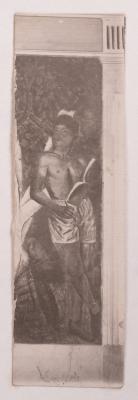
A. Ivanova. Painting of the Serpinski Room
unknown

Basic information
- ID
- Ivanova-68
- Author
- unknown
- Name
- A. Ivanova. Painting of the Serpinski Room
- Date of creation
- 1936
- Technique
- photograph (printed on paper)
Additionally
- Genre
- indoor scene
- Provenance
- Antonina Ivanova's archive
- Place
- Moscow (the USSR)
Information about author
Object description
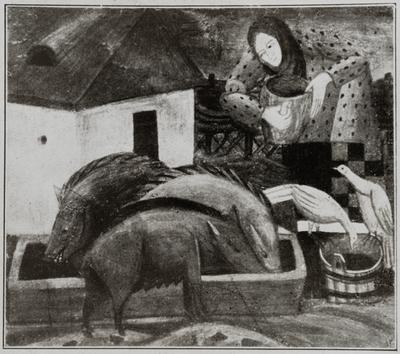
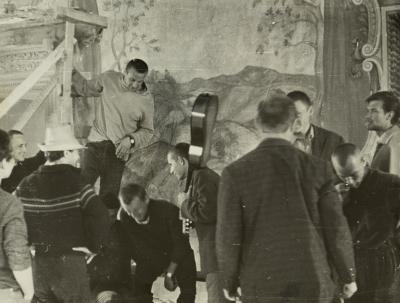
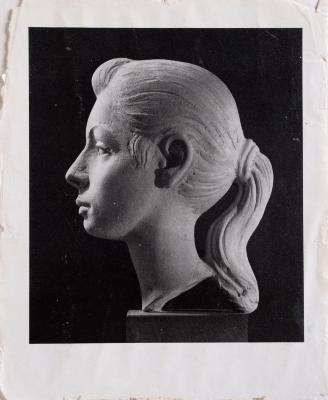
The russian-language inscription on the back of the photograph, written in blue ballpoint, reads: "Ivanova A.M. Painting of the Serpinski Room 1936 (based on a Ukrainian carpet) Moscow". Antonina Ivanova's archive contains another photograph of another mural, probably in the same room of the Serpinski – "Conversation at the Table" by Voronov, dated 1926. In the background, we can probably see the same plane with a door frame and technical holes for the stove, which the artist painted ten years later, in 1936, as her signature indicates. This painting is peculiar because it is also based on folk art and professional painting of the 17th and 18th centuries. Thus, the carpet-like composition is complemented by a motif known from the practice of national sacred art, namely the symbolic image of the pelican. The accompanying text to a similar painting reproduced in Pavlo Zholtovskyi's book "Artistic Life in Ukraine in the 16–17th centuries" (Kyiv, 1983. p. 36–37) states that "such widespread in the 17–18th centuries symbolic compositions as "The Crucifixion with the Vine", "Christ in the Grapevine", "Christ the Grapegrower", "Christ in the Cup", "The Waking Eye", "The Pelican", and "The Fruits of Christ's Suffering" were intended to reveal the Christian dogma of the Eucharist, the atoning sacrifice of Christ. The proliferation of such themes in Ukrainian painting in the late seventeenth and especially in the eighteenth century was due to the development of scholastic theology in Ukraine, polemics with Catholicism, and the fascination with allegorical and symbolic means of literary and artistic expression. At the same time, it should be noted that most of these images had certain connections with the images of folk art, in particular with the 'Tree of Life'". Among the sources of these theses, Pavlo Zholtovskyi cites the publications of Danylo Shcherbakivskyi ("Symbolism in Ukrainian Art". Kyiv, 1921) and Natalia Kotsiubynska ("Pelican in Ukrainian Art". Kyiv, 1926), so we will focus on the latter. In her analysis of the iconography, N. Kotsiubynska states that the allegorical image of the pelican "has nothing in common with the real one" and is rather based on the owl (p. 230). However, given the texts of Western bestiaries, the idea of associating the image of the pelican with Christ probably arose because this bird is "the most child-loving of all birds" (p. 231). In particular, as Natalia Kotsiubynska points out, "the Christian cult makes the pelican Christ, who animates the faithful with his blood, a symbol of its highest mystery, the Eucharist" (p. 231). Regarding the practical application of pelican iconography in national art, the researcher points to Samuel Myslavskyi's sakkos from the Kyiv Lavra Museum, numerous "kuzhbushky" (art books that served as a model for Ukrainian icon painters in the 17th century) and old prints from the Kyiv-Pechersk Holy Dormition Lavra and the painting from the Gate Church of the Trinity of the Ukrainian Orthodox Church of the same complex, as well as paintings from the Chernihiv, Kharkiv, and Katerynoslav museums (pp. 232–240). However, the source of the painting – the "Ukrainian carpet" – deserves special attention in terms of the development of the structure of the painting and was probably mentioned by Antonina Ivanova herself. Natalia Kotsiubynska also has some important theses: "There is a pelican in the fabric on eighteenth-century carpets. We have some carpets with pelicans in the Poltava Museum of the Former Provincial Zemstvo. Two of them were published by the Drukar Publishing House (sewing and fabrics section)" (p. 240). The researcher goes on to give a description that is consistent with the one depicted in Antonina Ivanova's painting: "Against the clear background of the first carpet, among the flowerpots and tassels scattered in rows, a pelican with small children stands in profile above the nest in the middle, raising its wings and tearing its chest with its beak. The colour of its body is dark with some white feathers (it looks like a mottled bird) (...) The pelicans look like either twigs or animals" (p. 240). As we know, Antonina Ivanova was engaged in research and the processing of scientific sources. The study of the artist's archive, especially her correspondence, confirms this, as does her work at the Department for the Study of the Art of the Peoples of the USSR at the State Academy of Art Sciences in Moscow (this institution functioned in 1921–1931). Therefore, we can assume that the artist was familiar with this text, as well as with the carpet described by Natalia Kotsiubynska, since this publication appeared in 1926 in the Notes of the Historical and Philological Department of the Ukrainian Academy of Sciences (Book IX, chief editor Academician Agatangel Krymskyi), and the mural, as mentioned above, is dated 1936. Another aspect that deserves attention is the symbolism of Antonina Ivanova's mural in general and, more specifically, in the context of the interior design of a private house. For example, researcher Olha Khutorianska notes that the presence of variable floral motifs next to the symbolic image of Christ the Pelican allows us to interpret Antonina Ivanova's painting as an allegorical image of paradise as a beautiful garden (this may have some connection with the purpose of the stove, which is the heart of the house, warming and sustaining life in this space). In general, this painting is evidence of serious preparatory work for the development of an artistic image, justification of the ideological component, and a consistent statement of the artistic phenomenon often referred to as "Boichukism".
Legal regulation
Borys Voznytskyi Lviv National Art Gallery