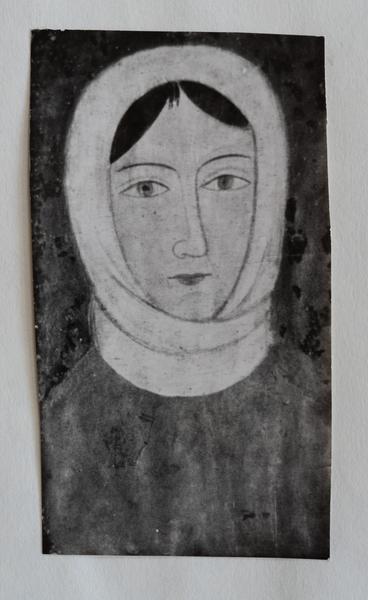
A. Ivanova. Head of a Girl
unknown


Basic information
- ID
- Ivanova-65
- Author
- unknown
- Name
- A. Ivanova. Head of a Girl
- Date of creation
- 1920
- Technique
- photocopy (printed on paper)
Additionally
- Genre
- portrait
- Provenance
- Antonina Ivanova's archive
- Place
- Lubianka village, Kyiv region (the Ukrainian People's Republic ?)
Information about author
Object description
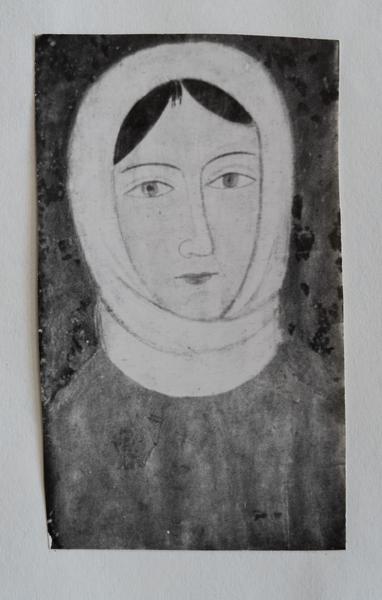
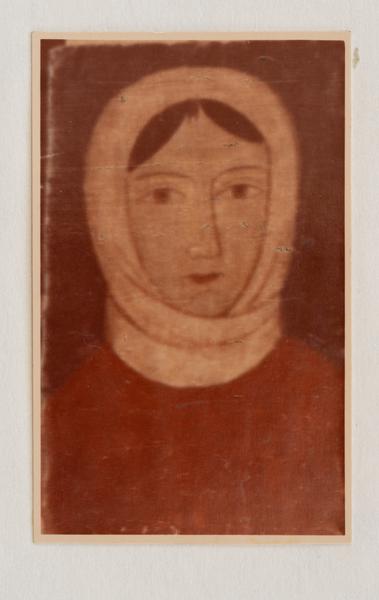
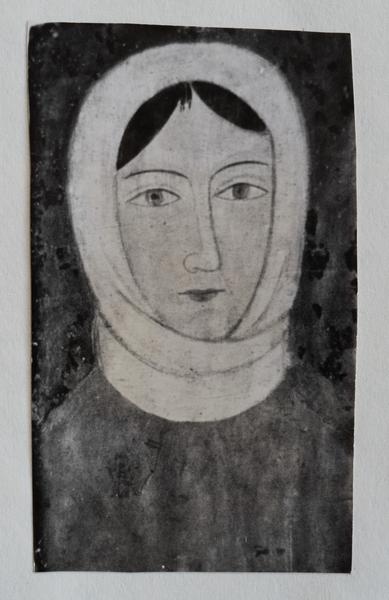
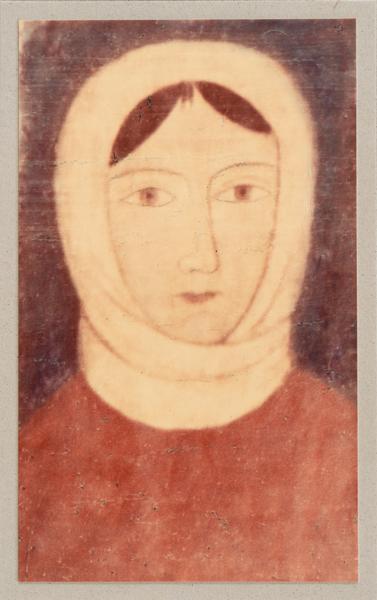
A simple pencil inscription below the photograph in Ukrainian and russian reads: "Ivanova A.M. Girl's head. Kyiv. 1920. Lubianka village, the house of Yarmola Ivan, the owner of the house where I lived when I was a teacher". The style of the work is an expressive example of the practices of Mykhailo Boichuk's circle, as Antonina Ivanova demonstrates through this painting of a girl, in which direction sacredness could develop, or to some extent the phenomenon of "post-icon". The work has been photographed in several versions: in colour (the correspondence with the original is questionable) and in black and white. Regarding the visual characteristics, the author's interpretation of Orthodox iconography can be found at the level of perspective, flat stylisation, and the search for the most expressive features. For example, the type of hairstyle with several small strands, the approach to the forehead, eyebrows, eyes and nose have clear parallels with iconography, in particular, the type of face and interpretation of the hair of the Saviour of the World from the 11th century (State Tretyakov Gallery, russia), and at the same time demonstrate Antonina Ivanova's appeal to the fundamental theological concept that every human being is an icon because he or she is created in the image and likeness of God (Genesis 1:26–27).
Legal regulation
Borys Voznytskyi Lviv National Art Gallery