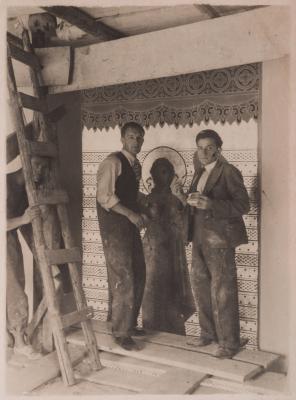
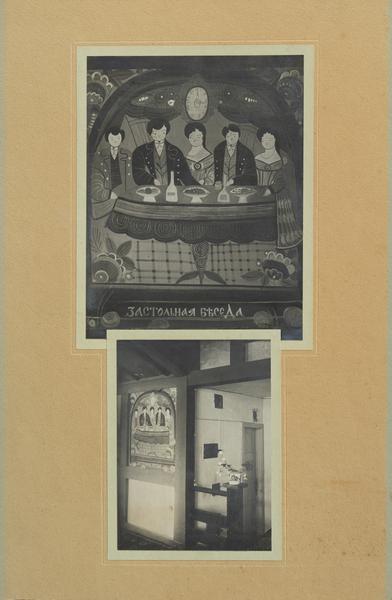
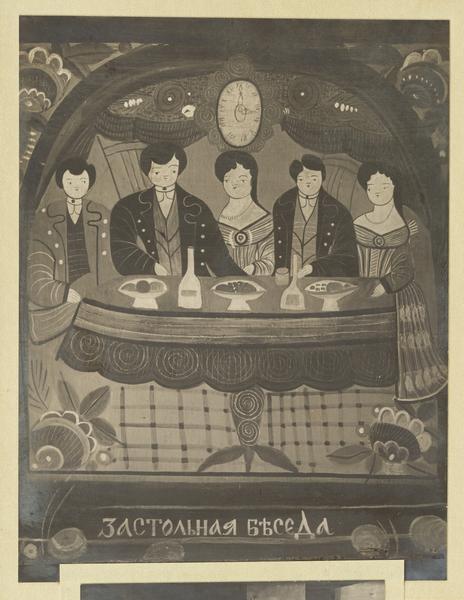
Conversation at the Table by V. Voronov. Painting in the Serpinski Room
unknown


Basic information
- ID
- Ivanova-24
- Author
- unknown
- Name
- Conversation at the Table by V. Voronov. Painting in the Serpinski Room
- Date of creation
- 1926
- Technique
- photograph (printed on paper)
Additionally
- Genre
- indoor scene
- Provenance
- Antonina Ivanova's archive
- Place
- Moscow (the USSR)
Information about author
Object description
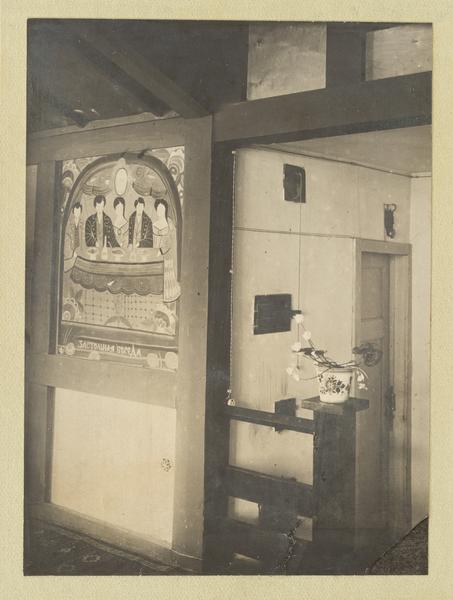
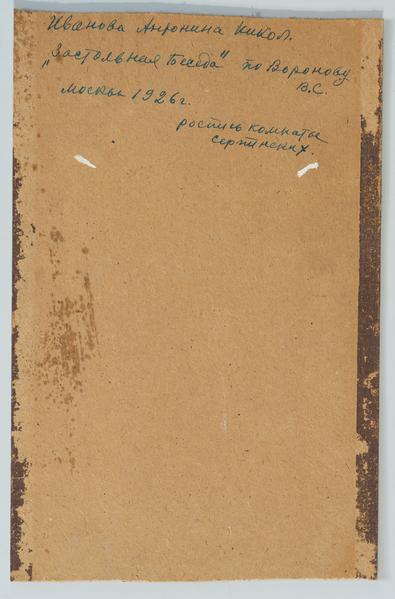
On the back of the photographs is a russian-language inscription in blue ink: "Ivanova Antonina Nikolaievna. 'Conversation at the Table' by Voronov V. S. Moscow 1926. Painting of the Serpinski Room". The two photographs, pasted on a single sheet of cardboard, depict a folk-style painting based on images published in Voronov's book "Christian Art". In this edition, on the insert between pages 84 and 85, there is a colour image of a similar scene with the caption "Painted dontse. Detail. Scene of a table talk. Nizhny Novgorod painting". (Dontse is an ethnographic name for the lower part of a hand-spun spinning wheel decorated with painting or carving). In a later publication by S. Zhehalova on folk painting (Moscow, 1984, pp. 149, 151), there are works by Ihnatii Mazin (1876–1942), a master of Horodok painting of the late 20th and early 21st centuries, similar in subject and colour. The iconography of this scene, executed in the mural by Antonina Ivanova, combines reminiscences of iconographic practices, particularly the composition of the Last Supper, with variable scenarios of demonstrative feasts (S. Zhehalova notes a certain "photographic nature" of such compositions with motionless figures posing as if in front of a camera, or rather in front of a direct-view camera in the focal plane of the lens). The influence of Mykhailo Boichuk's circle is also evident in this work, not in terms of stylistic approach but indirectly through the iconographic nature of the subject and attention to the understanding of folk art practices. The interior in the photo below stands out for its design peculiarities, as it shows the tendencies of Soviet modernism of the 1920s, especially constructivism. For example, the visual similarity with the entrance group in the interior of the studio house of the architect Konstantin Melnikov (1927–1928) suggests that the room where Antonina Ivanova painted was either built in the 1920s or was significantly reconstructed in that period with the introduction of the stylistic trends of the time. Due to the division of the wall by wooden structures, the mural is perceived as a painting rather than a fresco. As for the peculiarities of the layout, an original solution was applied to the location of the stove – one of its parts is embedded in the wall next to the door (indicated by the technical door). In order to create a certain "homely" atmosphere, there is also a white painted flowerpot decorated with floral motifs on a special stand next to the front door, in which one of the varieties of cyclamen common at the time is growing.
Legal regulation
Borys Voznytskyi Lviv National Art Gallery