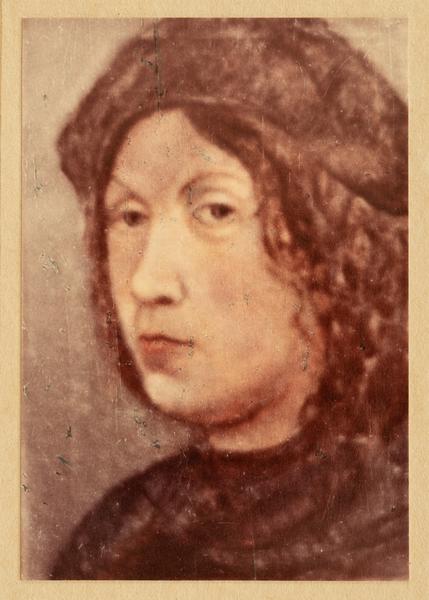
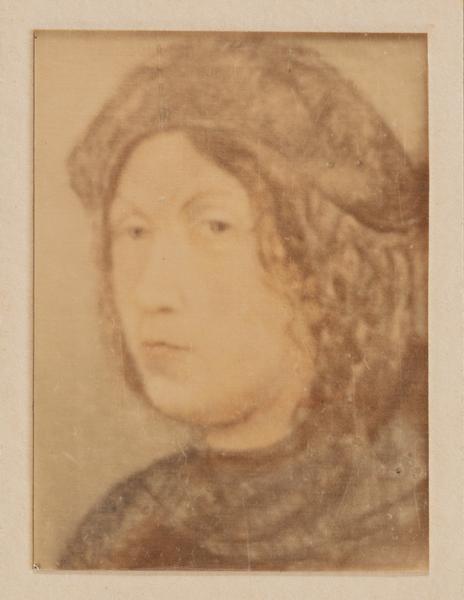
A. Ivanova. Self-Portrait
unknown


Basic information
- ID
- Ivanova-74
- Author
- unknown
- Name
- A. Ivanova. Self-Portrait
- Date of creation
- 1929
- Technique
- photocopy (printed on paper)
Additionally
- Genre
- portrait
- Provenance
- Antonina Ivanova's archive
- Place
- Moscow (the USSR)
Information about author
Object description
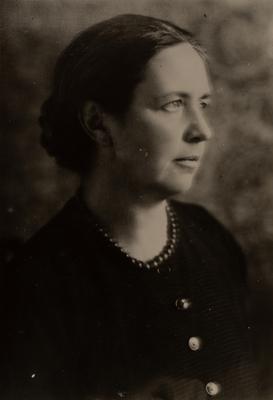
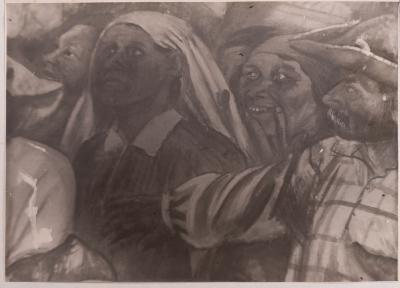
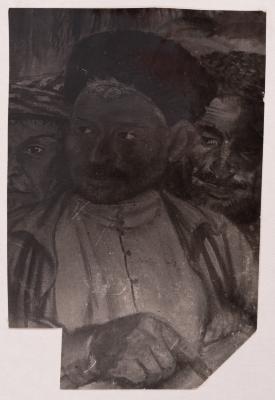
On the back of the photograph is an inscription in russian, written in blue ballpoint pen: "Ivanova A.M. Self-portrait. 1929 Moscow". The original work is in the collection of the Gallery (Ж-5145, oil on canvas). The format of this work is quite compact (35 x 25.5 cm), but it should be noted that in a certain sense, we can see not only the artist's self-reflection but, above all, who the artists thought of themselves at that time. Undoubtedly, we are looking at the logical result of a particular period in the creative activity of Antonina Ivanova, who at that time had already formed not only knowledge, skills, experience and quite significant results of her work, but, above all, she had formed a holistic view of the world. The latter probably became a prerequisite for determining the source of inspiration, according to which the composition was formed, and the figurative solution was chosen. In our opinion, such a source was, in particular, the paintings of the quattrocento and cinquecento periods, which were probably the prerequisites for these allusions. It is worth considering the hypothesis put forward by the researcher Olha Khutorianska on the influence of the painting of a boy by Bernardo di Betto di Biagio (Pinturicchio) from the collection of the Dresden Art Gallery (1500) and the portrait of Andrea Navagero and Agostino Bezzano (1516, Galleria Doria Pamphili, Rome), a work by Raphael Santi, an artist with whom Pinturicchio studied under Perugino. In our opinion, this thesis has been confirmed, and it is therefore advisable to turn to Raphael's practice of self-portraiture. As far as the latter is concerned, both Raphael's famous self-portrait in the Palatine Gallery in the Pitti Palace in Florence (1504–1506) and the artist's image in the fresco "The School of Athens" in the Stanza della Senatura in the Vatican (1510–1511) are stories about time and himself in time. Furthermore, in the case of Raphael's self-portrait from the Stanza della Signatura (Raphael's Room), the context of world history unfolds before us, from Pythagoras, Socrates, Plato, Aristotle, Alexander the Great, and Hypatia to Abu al-Walid Muhammad ibn Ahmad al-Qurtubi, in which the artist is one of the participants, and in the case of this work by Antonina Ivanova we see rather a reflection on who the artist is in the current difficult period of the post-revolutionary events of 1917, when the world has indeed changed its vector of movement – from radical transformations of the map of Europe to radical innovations in all areas of culture, from music and literature to visual practices. In many ways, Antonina Ivanova's painting is an attempt to relate herself, a person who changed the world, to the person who became one of the symbols of the transformation of art in his time. At the time when Antonina Ivanova painted her self-portrait, conservative and radical art associations were still functioning, such as the Association of Revolutionary Art of Ukraine, 1925–1932, the Association of Artists of Red Ukraine, 1923–1930 (from 1930 – the All-Ukrainian Association of Proletarian Artists), the Association of Artists of Revolutionary russia, 1922–1932, and the Society of Easel Artists, 1925–1931. As early as 1929, however, certain tendencies began to emerge, which became a prerequisite for the reduction of the diversity of artistic practices that finally took place after the resolution of the Politburo of the Central Committee of the Communist Party of the Soviet Union (b) No. 97 of April 23, 1932 "On the restructuring of literary and artistic organisations" and the unification of artistic activity within the official Union of Artists. To a certain extent, it can be argued that Antonina Ivanova was already building her world at the end of the 1920s, in which, through a certain escapism, it was possible to separate oneself from unacceptable or traumatic manifestations of reality. After all, the world in which one can feel like a vicarious visitor of those who have remained for us in their works – images and texts – can often be much closer to reality than the current historical process.
Legal regulation
Borys Voznytskyi Lviv National Art Gallery