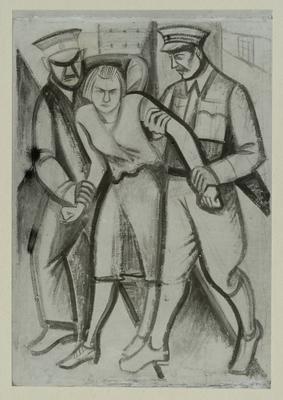
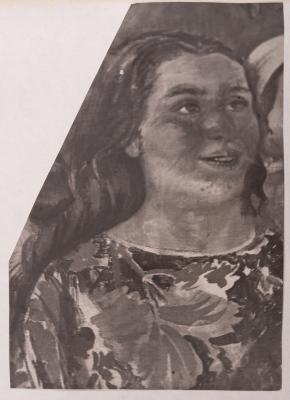
A. Ivanova. Sketch for the Panel "Friendship of Nations" (?) or a Variant of the Composition "We are for Peace"
unknown

Basic information
- ID
- Ivanova-53
- Author
- unknown
- Name
- A. Ivanova. Sketch for the Panel "Friendship of Nations" (?) or a Variant of the Composition "We are for Peace"
- Date of creation
- 1936; 1944
- Technique
- photocopy (printed on paper)
Additionally
- Genre
- group portrait
- Provenance
- Antonina Ivanova's archive
- Place
- Moscow (the USSR)
Information about author
Object description
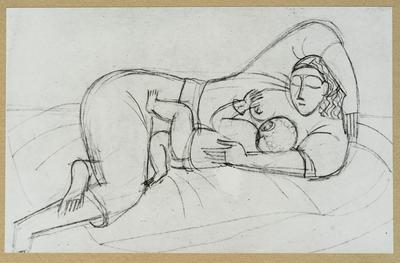
The author of the graphic work, its title, date and place of execution are indicated by a simple pencil inscription in Ukrainian under the photograph: "Ivanova A. M. 1936. Friendship of Nations / composition of a carpet. A. Ivanova / 1944 "We are for peace" Moscow". However, these statements should be taken with a grain of salt due to some factors. Yes, there is no doubt that this graphic work and the finished panel "We are for Peace" (painted on silk) from the Gallery's collection share many distinctive similarities. However, in the case of the finished work, the woman is holding a slogan with the inscription "We are for peace", and in the case of this print, the inscription contains the Roman numerals "XXX... [further illegible]" and the signature in Russian "years". In this case, it could refer to the anniversary of the October Revolution (30 or 35 years, in which case the date would be 1947 or 1952) or to the creation of the USSR (in which case it would be 1952 or 1957), although it is difficult to say for sure which of these events is significant. There are also certain similarities with the Friendship of Nations but many more differences. The fact that this graphic sketch could have been a transformed version for a carpet with an ideological narrative can be argued based on the presence of such a technique, particularly during the period when Stalin was Secretary of the Central Committee of the All-Union Communist Party of the Bolsheviks (1934–1953). For example, in Fedor Gogel's edition of Carpets (Moscow, 1950), the section on carpets of the Soviet Union mentions the active introduction of carpets with ideological themes in the 1920s and 1930s, and, in particular, a piece "...dedicated to the friendship of peoples with the image of Comrade Stalin, presented at the All-Union Agricultural Exhibition" (p. 26). This work is reproduced on the insert next to the text, a work by unidentified Turkmen masters, surrounded by stripes with images of horsemen along the perimeter of the main realistic portrait, which is in tune with Antonina Ivanova's work. However, this is an exception, as the main decorative motifs in carpets of this type are mainly stylised floral elements or ornamental and geometric forms. Antonina Ivanova's work on the development of the carpet may be one of the experiments (or the realisation of an order) related to the professional and friendly communication with Serhii Kolos, with whom the artist studied in Kyiv with Mykhailo Boichuk (there are preserved letters in the Central State Archive-Museum of Literature and Art of Ukraine). The academic Yakym Zapasko once wrote about the work of Serhii Kolos (Essays on the History of Ukrainian Folk Art. Lviv, 1969. P. 150 and in the monograph Ukrainian Folk Carpet Weaving. Kyiv, 1973. P. 66): "In the second half of the 20s portrait carpets appeared. A typical example is the carpet with the portrait of Karl Marx, made by the experienced master of folk art S. Kolos". In connection with carpet weaving in the Ukrainian SSR, Y. Zapasko also notes the practices of other students of Mykhailo Boichuk, in particular M. Rokytskyi and I. Padalka (Zapasko, 1973. pp. 68–69). In general, the question of the exact date of Antonina Ivanova's sketch, its exact title and the type of product remains open, as it could be either the 1930s or the 1940s–1950s. In addition, as we know from photographs in Antonina Ivanova's archive and the surviving graphic sketches, the artist often combined different motifs from different periods, making it difficult to establish the exact production time, especially in the absence of a finished original.
Legal regulation
Borys Voznytskyi Lviv National Art Gallery